
London 2012 torch for sale on eBay - Yahoo! Eurosport

The unnamed seller's location was given as Probus in Cornwall, the south-west English county where the relay had started in the morning after the flame was flown in from Greece on Friday.
The Sun named the seller as Andrew Bell, who finished his leg of the relay in Marazion. He was nominated for the relay as a result of his coaching and fundraising efforts for a local rowing club.
He told the paper that the torch - pictured with triple Olympic yachting gold medallist Ben Ainslie - looks "weird" in his home and said he needed the money.
"I understand some people may find the idea of selling an Olympic torch offensive but we could genuinely use the money," he said.
"Without giving you a sob story, we've a lovely baby boy and my wife has just gone back to work after maternity leave.
"Also, the torch is nearly a metre long and looks weird on the mantelpiece."
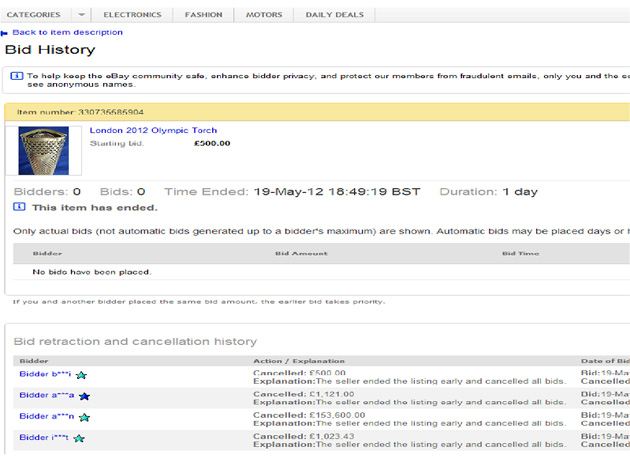
Put on sale at midday, the items had attracted 24 bids by 5.30pm with the price soaring above £3,000.
However a raft of what appeared to be fake bids sent the figure to £50,000 and Bell ended the auction early shortly after 6pm, cancelling all bids.
Some of the bearers nominated by the relay sponsors have been allowed to keep their triangular-shaped torches, made of gold-coloured aluminium and perforated with 8,000 holes, at no cost while others have been asked to pay for theirs.
Several other torches have since been listed on the auction website, most of them in advance of the people taking part in the relay.
Organisers LOCOG had set a cost for their nominees of £199 if paid for before May 1 and £215 thereafter. They said they are actually worth £495.
"The torch and uniform are the torchbearer's to do what they want with, we hope they find a good home," said a London 2012 spokesperson when asked about the eBay sale.
Some 90 per cent of the torchbearers were nominated through public campaigns, with the emphasis on rewarding local heroes and those who have made a difference to the communities in which they live, and the rest selected by invitation.
Banners and publicity emphasise it as the "Moment to Shine".
The relay started at Land's End on the south-west tip of England just after 7am with Ainslie handed the honour of completing the first 300 metres.
Some 8,000 people are due to take part in the relay around Britain and into Ireland before the cauldron is lit at the opening ceremony on July 27.
One seller jokingly listed 'Not a London 2012 Olympic Torch' with the following description:
"I don't have an Olympic torch or uniform and, to be honest, couldn't give a monkeys about the Olympics.
"However, I am skint and as the whole thing appears to be coming out of my taxes, I wouldn't mind a bit of cash back.
"Therefore, please only bid if you are willing to give me some money and get nothing in return except good feedback and a warm feeling having done a good deed.
"Remember, you are bidding to be the person that gives me some money and will get nothing in return except my thanks. Paypal only please. Non payers will be hunted down and made to watch repeats of the X Factor for 24 hours non stop."
Transforming London for Olympics inspires a way to unite British business - The Independent
Back in 2004, Athens got a new tram and light rail line, along with much-needed upgrades to the metro system and the Ring Road. Four years ago, Beijing opened the world's second largest airport terminal inpreparation for the Games, along with seven new underground lines and 80 new stations. London is also undergoing transformation, even at this late stage – from changes as subtle as the imminent introduction of wi-fi access at selected underground stations, to the more profound transformation of the area around Stratford in East London.
The development has not been without its detractors (not least due to of the amount of money spent in a time of supposed austerity) but when you arrive in E15 and move through to the new E20 postcode of the Olympic Park, it's impossible to remember how it used to look.
The metamorphosis is almost complete. You can get a perfect bird's-eye view of last-minute preparations at the Olympic Park– including the Olympic Stadium, the Aquatics Centre and Britain's largest piece of public art, the Arcelor-Mittal Orbit–at Cisco House, a temporary structure just opened on the edge of the new Westfield shopping centre. This idea of the Games being associated with transformation is one that Cisco, as the official network infrastructure supporter of the Games, is keen to get across. And indeed, it's the whole raison d'être behind the Cisco House project. Built over an eight-week period this spring, it's a kind of technological show-home for businesses, designed to communicate the importance of technology – specifically, how the same network infrastructures that underpin the Olympics can revolutionise ourworking methods and procedures.
It's a hands-on, interactive experience, with touch-screens everywhere you look, but crucially, it's not an guide to Cisco or the things it actually manufactures and constructs; rather the possibilities that spin off from that.
"We're not showing people what a switch looks like, and how many inputs and outputs it has," says Cisco's Dom Joyce. "This is more about an ecosystem, how companies come together." There's an apposite demonstration of this "ecosystem" on this particular day. CiscoHouse is hosting TeenTechCity, an event that brings together teenagers from 15 schools across East London, innovative companies from the same part of the world – including Glass Eye, Pavegen and Sugru – and a variety of more established business such as Thames Water, BT and the BBC.
TeenTech, which operates under the slogan "Inspiring Tomorrow's Innovators", was founded by broadcaster Maggie Philbin in an attempt to instil an enthusiasm and excitement about science and technology into young people – people for whom "fame" has perhaps become a primary ambition. "A generation sit in classrooms convinced that subjects like maths and physics are irrelevant," she says – and that seems to be backed up by a multiple choice question she fires at the teenagers this morning. She asks them what their image of a scientist is: the consensus is "clever, well-paid, but boring".
Today at Cisco House, however, the kids are surrounded by people and concepts you'd have trouble filing under "boring". And, after a couple of hours of interaction, you sense the message is getting through. An "ideas wall" starts fillingup with Post-it notes on which tomorrow's blue-sky thinkers have outlined their own futuristic concepts, ranging from robotic litter pickers to hover wheelchairs, through to chicken that "cooks instantly". Hey, we all have to eat.
Away from today's frenetic activity in the main part of Cisco House are a number of meeting rooms equipped with TelePresence, and a whole heap of hidden technologies operating quietly in the background: virtual desktops, data storage, processing power. And then there's the Business Transformation Experience, a name which perhaps promises more than it delivers, but nevertheless offers an excellent summary of the ways in which technology is changing our working lives.
In a mocked up underground carriage complete with a discarded Metro newspaper (realistic!) we're asked to don 3D spectacles (slightly less realistic), at which point Stephen Fry suddenly appears, wanting to take us on a journey: "All stations to a connected world!" We're shown numerous examples of the increasing importance of networks, both locally and globally; from revamped communication systems across a hospital building that help save lives, to General Electric's video-conferencing system that helps co-workers collaborate in real time over vast distances, to the way in which virtual characters like Moshi Monsters have captured the imagination of children across the world.
Throughout Fry's presentation, it's the role of "the cloud" that's most frequently emphasised; the way in which the internet can quickly take the strain of increased demand for data when it's needed, for as long as it's needed. There's probably no better example of the flexible cloud in action than the Olympic Games itself; an event that will suddenly be shifting huge quantities of data from the 27th July to the 12th August – and then again for the Paralympics between 29th August and 9th September.
You're reminded of the role of technology during the Olympics when you take a walk out onto the balcony of Cisco House and look out across the site; a touch-screen gives you a guide to the various buildings across the Olympic Park, and the formidable technological challenges that the event will pose. As well as broadcast media pumping out HD-quality images, up to 200,000 people at a time could suddenly have the urge to tweet pictures, text or video; that requires robust connectivity that will stretch across all of the Olympic venues. Shortly after the Paralympic Flag has been lowered, Cisco House will also be closed. During its four month lifespan around 11,000 people will pass through its doors – from the teenagers attending TeenTechCity, to local people participating in team building events, to business leaders indulging in a bit of corporate hospitality. "But it's corporate hospitality with a message," says Cisco's Dominic Cook – and one of those messages is the legacy the company is hoping to leave behind, post-Olympics.
"We've made a five-year commitment to learning and innovations in East London," says Dom Joyce. "It's in our interests to encourage kids; they're our staff of the future. If they don't have the skills, we can't recruit." So if you find yourself watching the Olympics this summer, and suddenly see a tall structure tinged with green and turquoise, that's Cisco House; yes, it's partly an exercise in corporate flag-waving, but it's also inspiring individuals, businesses and young people to recognise the transformative power of technology.
In association with Cisco, Official Network Infrastructure Supporter for London 2012
Jessica Ennis angry at farcical error in Manchester 100m hurdles race - The Guardian
A technical hitch in the 100m hurdles left Jessica Ennis frustrated here on Sunday after the poster girl for the London Games thought she had run a personal best, only to discover that officials had laid out only nine hurdles on the track running through the centre of Manchester instead of 10.
The 26-year-old heptathlete had been delighted on crossing the line, punching the air to celebrate a new best time of 12.75sec, having beaten two world‑class hurdles specialists in the defending Olympic champion, Dawn Harper, and the world silver medallist, Danielle Carruthers, at the Powerade Great CityGames. But within minutes suspicions arose that something was amiss as Ennis's British rival, the Olympic bronze medallist Kelly Sotherton, tweeted: "Thought 100m hurdles was great but I'm sure that there was only nine hurdles not 10."
"I feel let down," said Ennis, in a rare show of frustration. "I felt like it was a good race, I was running well, I was obviously coming through at the end, stick another hurdle on there it would have been the same outcome but, argh, I'm so annoyed. What can I say? I've still had a good competitive race but I've just not got the result that I wanted."
Neither Ennis nor her coach, Toni Minichello, had had any inkling of a mistake following the race, with the Sheffield athlete confirming that she had never experienced such an error, even at school-level competition. "I can't believe that. It's a great event but that's a massive, massive mess-up … As an athlete you expect that everything should be set up properly and there should be no mistakes like that so I am pretty disappointed with that."
"I was just talking to Dawn Harper and to me it didn't feel any different but Gemma Bennett was saying she felt that it was a long run off, but you just run, don't you? You expect that all the hurdles will be out and everything's the way it should be and you just run as fast as you can and get across the line and that's what I did but unfortunately it wasn't set up right."
Ennis later joked that she would be counting the hurdles at her next competition, the IAAF multi-event challenge in Götzis, Austria, this weekend.
Sotherton, 35, who had entertained hopes of competing at the London Olympics in one final heptathlon, which looks unlikely after she withdrew injured this month from her first multi-event competition in four years, tweeted her regret over alerting the organisers: "I feel bad! People probably think I'm being a cow bag!"
The 35-year-old had a similar experience before the Beijing Olympic Games when the third hurdle in the race at Crystal Palace was positioned wrongly forcing her to pull up and the race to be annulled and eventually re-run at the end of the night.
the event organisers, Nova International, issued a statement to apologise. "We can confirm that due to human error only nine sets of hurdles rather than the required 10 were put out on track for the women's 100m hurdles event this afternoon. "
Dwain Chambers was greeted with applause from the Manchester crowd at his first appearance in the UK since the court of arbitration for sport ruling that cleared him to compete at the Olympic Games in London.
After getting a great start the 34-year-old faded to finish runner‑up in the 150m race with a time of 15.27sec. The US sprinter Wallace Spearmon, a world silver and bronze medallist over 200m, took the victory in 14.87sec, half a second off Usain Bolt's 2009 record mark of 14.35sec.
Chambers, who will attempt to qualify for the London Games at the Team GB trials in Birmingham next month, admitted to having been apprehensive before the race, unsure of how the public would react to his first paid appearance on home soil in six years. "It is a great feeling," he said. "This has been a special day. I was unsure how the reception would be. I was a bit scared, to be honest. But it was really good. It's been a long time since I've been able to compete in front of a home crowd and that's been one of the missing pieces for me."
4 Auto Stocks That Could Sink By 2013 - Seekingalpha.com
by Daniel Green
General Motors (GM) will unveil a new strategy designed to turn its money-losing Opel/Vauxhall division around sometime next month. Press reports indicate that GM's European boss, Karl-Friederich Stracke, leaked what could be some of the details of this strategy to unidentified workers at an Opel factory in Ruesselsheim, Germany.
The focus of the strategy will be concentrating the production of the Astra model car at two factories instead of one. Astra is currently built at Ruesselsheim, Ellesmere Port in England and Gliwice, Poland. Recent news stories seem to indicate that GM will terminate Astra production at Gliwice and concentrate it at Ellesmere Port and Ruesselsheim. The company is currently negotiating with unions in England in order to add a third shift at Ellesmere.
The idea behind the restructuring is to cut costs and increase utilization of GM's European assets. The factories at Russelsheim and Ellesmere are currently operating below capacity. Stracke wants to maximize the use of resources by adding a third shift. Adding shifts and presumably workers at Russelsheim and Ellesmere is also designed to get more support from labor unions, whose support will be critical for any restructuring of Opel and Vauxhall.
This plan could increase GM's stock value if investors like it and unions accept it. If investors or unions balk, it could send GM's stock prices falling. Opel/Vauxhall reportedly lost $256 million in the first quarter of 2012.
Chevy Going to Europe
General Motors is considering building Chevrolet brand cars in Europe. Chevy is apparently part of Stracke's restructuring plan, which seems to indicate that GM is acknowledging that its flagship brands have lost some of their appeal.
Chevy cars are currently sold in Europe, but they are manufactured in South Korea. Stracke's plan seems to indicate that the European Chevy would be made in conjunction with PSA Peugeot Citroen (UG.PA) in France. GM has had an arrangement with Peugeot for quite some time, but has not made much of it.
Chevy has been a huge success in China, where General Motors and its partner, the Shanghai Automotive Group, sold 972,369 vehicles in the first quarter of 2012. If GM could repeat that success in Europe, it would demonstrate that it is still a dominant force in the auto business. Successful production of Chevy in Europe would definitely help GM's stock value and augment the big success it has had in the U.S. and China lately.
The building of Chevy cars in Europe could give GM a new low-priced vehicle to compete with Japanese and Korean imports. It would also head off protectionist efforts from labor friendly European governments. In addition to that, the maximizing of resources and the use of existing assets could increase GM's market share and stock value in Europe.
If it is successful, Stracke's plan could rebuild General Motors' brand in Europe and stock value. Unfortunately, it is unclear how realistic this plan is, particularly with a massive drop in European car sales in the past year.
The plan does indicate that GM is committed to retaining a significant presence in Europe. Stracke also told workers and the press that General Motors intends to honor its pledge to keep producing cars at Russellsheim for another 15 years.
General Motors also seems intent on expanding Opel's brand overseas. It put out a statement indicating that it is looking at selling cars under the iconic German brand name in Australia, the Middle East, and South America. There is no indication that a market exists for Opels in any of those areas, so this move may not add to the earnings or stock value.
Opel definitely needs to expand beyond Europe, where auto sales outside of Germany and Great Britain have fallen off drastically because of the debt crisis.
Toyota Aims to Reclaim Lost Position in Europe
GM faces a host of problems in Europe, including a crowded auto market. In addition to home- grown competitors, such as Fiat (FIATY.PK) and Peugeot, it faces a fierce challenge from the major Japanese brands, including Toyota. Like GM, Toyota (TM) is committed to the European car market.
Toyota is planning to roll out two new models in Europe this year- the Yaris subcompact hybrid and the GT86 sports coupe (sold as the Scion FR-S in the U.S.). Toyota has been having problems in Europe in recent years, where its top selling position was taken by Volkswagen (VLKAY.PK) last year.
Toyota's market share has increased in the past year from 5.7% to 6.6%, which indicates that Europe's auto market is in flux. That could be good news for GM and its efforts to bring Chevy to a European audience, so. So it is possible that the company could add market share and increase its earnings per share.
This could also be bad news because Toyota seems to be making an aggressive push into the economy car market. That means it could be trying to take market shares away from the Astra, which is one of Opel/Vauxhall's flagship brands. A successful launch of the Yaris hybrid in Europe could hurt General Motors' stock.
Global Economic Woes Hurt Tata Motors
The global economic downturn is definitely hurting Tata Motors (TTM), which saw its stock values decline by 7% on Wednesday. The reason for the fall was obvious - Tata's sales, especially of its flagship Land Rover and Jaguar brands, are flat. Some analysts noted that the cause of the flat sales was turmoil in Europe, which is reducing car demand in that region.
That's certainly bad news for General Motors and Toyota as they try to expand their sales on the continent. It could also be the beginning of a general fall in auto stock prices, including such big brands as Toyota. The only thing keeping auto stocks from an even bigger fall is the great sales figures from the U.S.
Ford Admits that It Has Major Image Problems
Ford (F) has admitted that its iconic brand name has a serious image problem that could hurt sales. The company has even launched a new advertising campaign that does not show the Ford logo or mention the name Ford.
Business Week reported that the decision was made because of the results of consumer focus groups. The research indicated that consumers reacted favorably to new Ford vehicles, but not to the name Ford. The company's own director of marketing communications, Matt VanDyke, even admitted that the U.S. public has a negative perception of Ford.
That could be very bad news for a company in an increasingly competitive auto market. It also seems to indicate that U.S. auto makers have not overcome the negative reputation they have had for a long time. Such a reputation could definitely hurt the company's stock value. Not surprisingly, Ford's shares declined by 2.5% after this news came out.
Part of the problem is that Japanese brands, such as Toyota and Honda (HMC), have a far better reputation among U.S. car buyers, Ford's own chief of global marketing, Jim Farley, told reporters. Farley even admitted that buyers in U.S. population centers on the East and West coasts prefer Toyota and Honda to Ford.
Ford certainly is facing a problem: its U.S. market share has fallen to 15.4% even though it offers several models that offer excellent fuel efficiency. Part of the problem could be a management team that holds a press conference to tell reporters that consumers have a negative impression of it. That's exactly what Ford executives did, according to Business Week.
It goes without saying that such bone-headed moves are a great way to sink a company's stock value. Expect Ford stock prices to fall and keep falling for the foreseeable future unless the company develops some common sense. A good way to do this would be to stop reminding investors that consumers don't like their products. An even better way would be to develop some effective marketing campaigns.
Disclosure: I have no positions in any stocks mentioned, and no plans to initiate any positions within the next 72 hours.


0 Responses to "London 2012 torch for sale on eBay - Yahoo! Eurosport"
Post a Comment